An internal model at OpenAI has autonomously disproved a central conjecture in discrete geometry,1 a mathematical field with applications in cryptography, wireless device communication, and medical imaging. The proof relates to a famous question posed by Paul Erdős in 1946.2 It has been verified by prominent mathematicians in a companion paper.3
The verifying mathematicians consider this to be a genuinely novel breakthrough on one of the most discussed problems in this area of mathematics. One called it “arguably the best known problem in Discrete Geometry.” Another observed, “If a human had written the paper and submitted it to the Annals of Mathematics and I had been asked for a quick opinion, I would have recommended acceptance without any hesitation. No previous AI-generated proof has come close to that.”
The proof illustrates a general trend towards autonomous, agentic problem-solving in AI systems. OpenAI describes the system that produced the proof as a general-purpose model not specialized in mathematics. AIs can now perform long, novel chains of reasoning on difficult problems and are beginning to outstrip our ability to measure their progress.4
AI agents still perform best in domains with easily verifiable outputs, such as mathematics and cybersecurity. For example, Anthropic’s Claude Mythos found thousands of vulnerabilities across every major operating system and web browser, and was deemed too dangerous for public release.5 Such capabilities are why the government is now more interested in evaluating frontier AI models.6
AI research is also a field with many easily verifiable outputs. Researchers at OpenAI and Anthropic take advantage of this fact to accelerate their work; senior researchers now claim they make only high-level decisions and let AI handle most of the coding.7 Experimenting with the coding capabilities of a publicly available AI system, like Claude Code, immediately demonstrates how far AI has come in the last year.
OpenAI and Anthropic intend to use AI to enhance future models with minimal human oversight. To justify the urgency, these companies cite the importance of beating rival U.S. or Chinese labs.8 Many of the field’s foremost experts warn that this race ends with human extinction.9
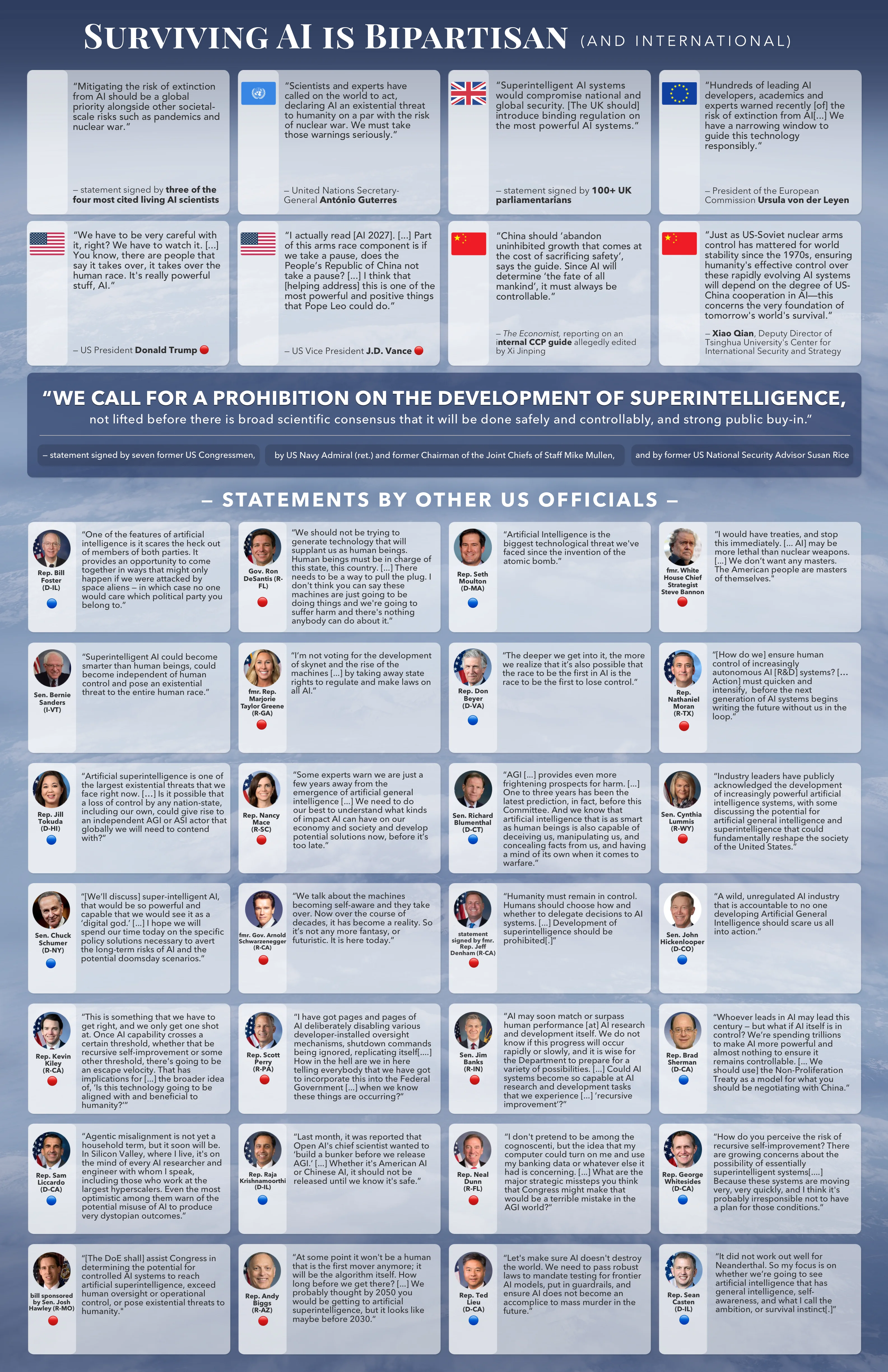
Policymakers and researchers, including the founders of the AI revolution, are calling for international restrictions on the technology.10 A growing bipartisan and international consensus of political leaders agree.11
Footnotes
- OpenAI, “An OpenAI Model Has Disproved a Central Conjecture in Discrete Geometry,” May 20, 2026, openai.com.
- OpenAI, “Planar Point Sets with Many Unit Distances,” May 20, 2026, cdn.openai.com.
- Noga Alon, Thomas F. Bloom, W. T. Gowers, Daniel Litt, Will Sawin, Arul Shankar, Jacob Tsimerman, Victor Wang, and Melanie Matchett Wood, “Remarks on the Disproof of the Unit Distance Conjecture,” May 20, 2026, cdn.openai.com.
- METR, “Task-Completion Time Horizons of Frontier AI Models,” accessed May 21, 2026, metr.org.
- Anthropic, “Project Glasswing: Securing Critical Software for the AI Era,” April 7, 2026, anthropic.com.
- Jacob Wendler, Dana Nickel, Dasha Burns, and John Hewitt Jones, “Trump Moves to Police Frontier AI Models,” Politico, May 20, 2026, politico.com.
- Sam Altman (@sama), “Yesterday we did a livestream. TL;DR: We have set internal goals of having an automated AI research intern by September of 2026 running on hundreds of thousands of GPUs, and a true automated AI researcher by March of 2028 . . . ,” X (formerly Twitter), October 29, 2025, x.com; World Economic Forum, “The Day After AGI,” YouTube livestream, January 20, 2026, youtube.com; OpenAI, “Introducing GPT-5.3-Codex,” February 5, 2026, openai.com.
- Dario Amodei, “On DeepSeek and Export Controls,” January 2025, darioamodei.com; Dario Amodei and Matt Pottinger, “Trump Can Keep America’s AI Advantage,” The Wall Street Journal, January 6, 2025, wsj.com.
- Center for AI Safety, “Statement on AI Risk,” May 30, 2023, aistatement.com.
- Future of Life Institute, “Statement on Superintelligence,” accessed May 21, 2026, superintelligence-statement.org.
- No Winners, “Bipartisan” graphic, accessed May 21, 2026, nowinners.ai.